

Every week across Discord, Telegram, and Reddit, the same pitch recirculates:
“Pass your $100K FTMO challenge in 48 hours on complete autopilot with our institutional HFT bot. 100% pass guarantee!”
Retail traders flock to these offers. They buy a $300 Expert Advisor (EA), load it onto MetaTrader 4 or MetaTrader 5, link their new prop firm evaluation credentials, click “AutoTrading,” and watch the bot fire 80 trades in twenty minutes. By the next morning, the account balance is up $8,200. The target is hit!
Then, the trader logs into their prop firm dashboard, eager to claim their Phase 2 credentials or submit their first payout request, only to find a red liquidation banner:
“Account Terminated: Prohibited Trading Strategy Detected (Latency Arbitrage / High-Frequency Execution).”
This is the harsh reality of algo trading prop firms in 2026. While the vast majority of Prop Firms proudly advertise that “EAs and algorithmic trading are fully permitted,” their compliance rulebooks contain dozens of fine-print restrictions designed to filter out toxic automated flow.
If you understand the structural difference between legitimate systematic automation and predatory trading strategies, algo trading remains the most powerful edge in prop trading. In this comprehensive guide, we dissect which prop firms truly allow automated trading, the 6 algorithmic strategies that will get your account permanently terminated, how compliance risk desks detect unauthorized bots, and the exact engineering blueprint you need to run EAs safely and scale funded accounts.
The Big Question: Are EAs Actually Allowed in Prop Firms?
The short answer is yes, but with strict conditions.
Proprietary trading firms can be categorized into two business models when it comes to algorithmic trading:
- B-Book Simulated Models (Evaluation Phase): During evaluation challenges, you are trading on a simulated demo server with virtual liquidity. In this phase, high-speed bots can theoretically exploit platform delay, latency slip, and synthetic order fills because no real market orders are being routed to liquidity providers (LPs).
- A-Book Pass-Through Models (Funded Phase): Once you manage substantial funded capital ($100,000 to $500,000+), reputable firms copy your trades or hedge their net exposure with Tier-1 liquidity providers (such as LMAX, Match-Prime, or IS Prime).
If an EA relies on toxic execution—such as firing 40 micro-orders within 300 milliseconds—an institutional liquidity provider will reject the orders, widen spreads to 25 pips, or disconnect the broker bridge. Because the firm cannot monetize or hedge that flow in the live market, they retroactively disqualify the trader under their “Commercial Abusive Trading” clauses.
Therefore, prop firms do not ban the technology of automation; they ban toxic order profiles.
The 6 Banned Algo Trading Strategies (The Compliance Blacklist)
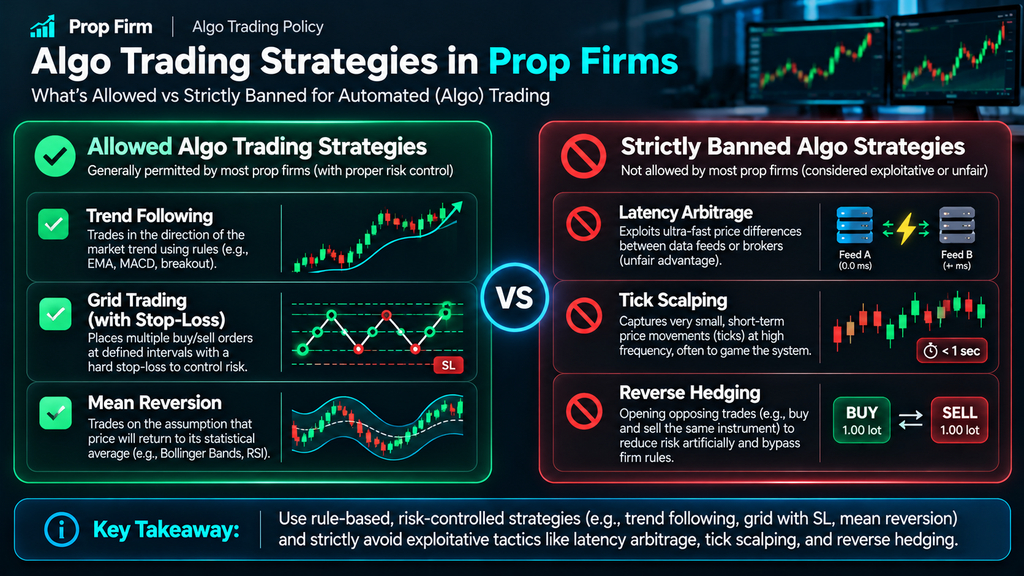
Before you attach any EA to a prop firm evaluation account, check its underlying logic against this compliance blacklist. If your bot uses any of the following six mechanics, your payout will be denied and your account will be revoked.
1. Latency Arbitrage & Feed Delay Exploitation
Latency arbitrage bots exploit microsecond price discrepancies between a slow broker feed (the prop firm’s MT4/MT5 demo server) and a ultra-fast institutional feed (such as CQG, Rithmic, or direct Bloomberg feeds). The bot detects that EURUSD has spiked 8 pips on the fast feed before the prop firm’s bridge has updated, enters a buy order, and exits 400 milliseconds later for an effortless profit.
- Why it is banned: It is an exploit of server infrastructure, not market edge. Liquidity bridges immediately flag trades held for sub-second intervals where entry occurred prior to price quote synchronization.
2. High-Frequency Trading (HFT) & Tick Scalping
True HFT involves executing thousands of orders per minute to capture fractions of a pip. While a few specialized prop firms permit HFT bots exclusively during Phase 1 of evaluation challenges (to collect evaluation challenge fees), 100% of these firms ban HFT on funded accounts.
- The Rule Threshold: Most firms enforce a minimum hold time (typically 30 seconds to 2 minutes). Any bot that scalps orders in and out within 5 to 15 seconds will be flagged for “Tick Scalping / Platform Overload.”
3. Reverse Hedging & Account Arbitrage
This strategy involves opening two identical evaluation accounts (either within the same prop firm or across two competing firms). An algorithm monitors high-impact economic news releases (like US Non-Farm Payrolls) and simultaneously opens a maximum-leverage Buy on Account A and a maximum-leverage Sell on Account B.
- Why it is banned: One account instantly liquidates, but the other account captures a 300% move and passes evaluation in 60 seconds. Prop firms use automated cross-broker compliance software (such as Centroid Solutions and Risk-Ops) that cross-references order execution timestamps across hundreds of firms. If your tickets mirror another account down to the second, both accounts are banned instantly.
4. High-Impact News Straddle Spikes
Some commercial bots place tight pending Buy Stop and Sell Stop orders 3 seconds prior to an interest rate decision or CPI print, hoping the breakout catches one side while canceling the other.
- Why it is banned: In live market conditions, spreads widen from 0.5 pips to 15 pips during news releases. Demo execution bridges fill pending orders at artificial prices that cannot be cleared in real interbank liquidity. Most firms prohibit automated orders 2 to 5 minutes before and after high-impact red-folder news.
5. Unconstrained Grid & Martingale Algorithms
Martingale bots double position sizing every time the market moves against the position (e.g., 0.5 lots, then 1.0 lot, then 2.0 lots, then 4.0 lots) without a hard stop-loss, banking on a retracement to escape with a small profit.
- Why it is banned: While technically allowed in some firms if a stop-loss is present, unconstrained Martingale algorithms have a mathematical probability of 100% catastrophic failure over time. A single sustained 150-pip trending move on Gold or GBPJPY will breach your 5% daily drawdown threshold within hours.
6. Mass Commercial “Off-The-Shelf” EAs
When an anonymous seller sells an MQL5 bot to 2,000 retail traders, all 2,000 traders run the exact same logic with the same default parameters and magic numbers.
- Why it is flagged: Compliance algorithms detect identical entry prices, lot multipliers, and exit timestamps across hundreds of evaluation accounts. The firm classifies this as “Group Trading / Copy Trading Rings” and issues mass account liquidations under violation of the single-trader rule.
How Prop Firm Risk Desks Detect Unauthorized EAs Behind the Scenes
Traders often wonder: “If my bot is private, how does the prop firm know what kind of EA I am running?”
Proprietary risk managers do not need to look at your source code. They analyze your Execution Telemetry through automated institutional broker bridge analytics:
Algorithmic Telemetry Audit Engine:
1. Trade Duration Distribution: Median holding time  FLAG: Tick Scalper
2. Order Cancellation Frequency: > 50 pending orders created/deleted per minute? -> FLAG: Server Spam
3. Slippage Symmetry: 100% positive slippage on limit fills? -> FLAG: Latency Arbitrage
4. Timestamp Clustering: Exact millisecond order alignment with other accounts? -> FLAG: Copy Trading Ring
Automated risk dashboards instantly sort all active accounts by volume variance, average duration, and order-to-fill ratios. If your account triggers an outlier score, your trading history is manually reviewed prior to any payout approval.
This is why professional algorithmic traders rely on quantitative performance journals like Anyted. Rather than guessing whether your automated execution violates compliance thresholds, Anyted connects directly to your Spotware cTrader Open API or parses MT4/MT5 statements to audit your trade durations, Peak-to-Trough Drawdowns, and MAE/MFE excursions. By inspecting your execution telemetry in Anyted, you can ensure your automated bot remains well within safe institutional parameters.
What Types of EAs ARE 100% Compliant and Scalable?
If toxic bots are disqualified, what automated trading strategies actually pass evaluations and receive consistent payouts?
The most successful algo traders in proprietary firms run systematic swing and intraday momentum models:
- Session Breakout Algorithms: Bots that identify Asian or London range consolidation and trade London/New York session expansion with fixed 1:2 or 1:3 risk-to-reward ratios.
- Mean-Reversion with Fixed Hard Stops: Algorithms that identify statistical extremes using Bollinger Bands, RSI divergence, or VWAP bands, executing with a mandatory stop-loss on every ticket.
- Multi-Timeframe Trend Following: Moving average confluence and momentum filters on 15-minute, 1-hour, and 4-hour charts that hold positions from several hours to 2 trading days.
- Execution & Risk Management Utilities: Trade assistants that automate lot sizing based on account equity, manage partial scale-outs, and trail stop-losses into breakeven.
Algo Trading Prop Firms: Complete EA Rules Comparison Table
Not all proprietary firms treat algorithms the same way. The table below breaks down the EA policies of leading proprietary trading platforms in 2026:
| Proprietary Firm / Platform | EAs Permitted? | HFT / Tick Scalping | Commercial / Third-Party EAs | News Trading Restrictions | Payout Safety Rating |
|---|---|---|---|---|---|
| PropPass (Standard & Pro Swing) | 100% Allowed | Protected Execution | Unique Logic Recommended | No Restrictions (Pro Swing) | 5.0 / 5.0 (Instant Rules) |
| FTMO | Allowed | Strictly Prohibited | Allowed with Unique Settings | 2-Minute Window on Funded | 4.8 / 5.0 (High) |
| FundedNext | Allowed | Prohibited on Stellar | Permitted with Custom Logic | 2-Minute News Policy | 4.6 / 5.0 (High) |
| Apex Trader Funding | Allowed | Strictly Prohibited | Allowed | Halts During Major Releases | 4.5 / 5.0 (Moderate) |
| Funding Pips | Allowed | Hold Time > 30s Required | Discretionary Flagging | News Execution Bracketed | 4.2 / 5.0 (Moderate) |
| Infinity Forex Funds | Evaluation Only | Phase 1 Only (Banned Live) | High Disqualification Rate | Banned | 2.5 / 5.0 (High Risk) |
Notice the critical distinction: modern evaluation suites like PropPass are engineered specifically to provide transparent rule guardrails.
On the PropPass multi-chart 60 FPS WebTrader, traders can test and refine their automated setups without fear of arbitrary retroactive disqualifications. With built-in Drawdown Guardian tracking and pre-trade buffer alerts, PropPass gives you the institutional environment needed to validate your trading bots before risking private capital.
The 4 Engineering Rules to Make Any EA Prop-Firm Compliant
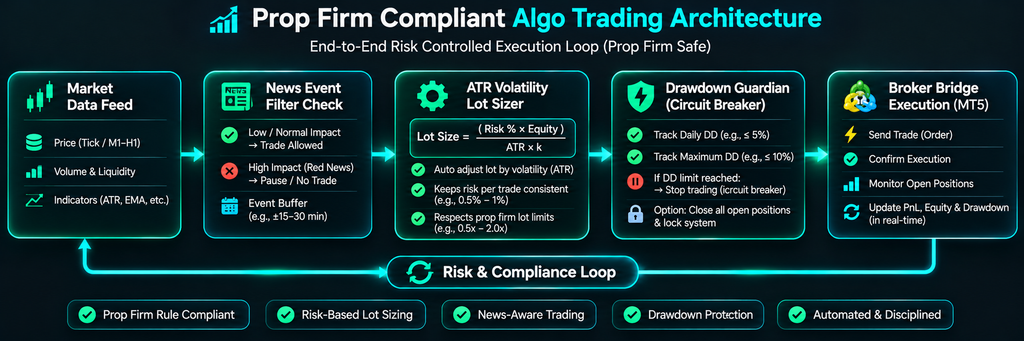
If you code in MQL4, MQL5, Python, or cTrader C#, implement these four architectural rules directly into your bot’s core logic:
Rule 1: Hardcode an Automated Daily Risk Circuit Breaker
Never rely on the prop firm’s broker server to enforce your daily drawdown. If high volatility causes slippage, the broker will liquidate your account.
Build a local equity monitor into your EA’s OnTick() loop:
Daily Risk Circuit Breaker Logic:
- Starting Day Equity = AccountBalance() at 00:00 UTC
- Max Permitted Loss (3.5%) = Starting Day Equity * 0.035
- Current Day Floating Loss = Starting Day Equity - AccountEquity()

IF Current Day Floating Loss >= Max Permitted Loss THEN:
    1. CloseAllOpenPositions();
    2. CancelAllPendingOrders();
    3. GlobalVariableSet("HALT_TRADING_TODAY", 1);
    4. SendAlert("Daily Risk Ceiling Hit. Bot Paused Until Next Session.");
By capping your daily automated drawdown at 3.5% on an account with a 5.0% prop limit, you leave a 1.5% safety cushion for slippage and spread widening.
Rule 2: Randomize Order Execution Jitter
To prevent compliance filters from grouping your EA with hundreds of other traders running similar strategies, introduce an execution jitter parameter:
- When a buy or sell signal triggers, insert a randomized sleep timer between 300ms and 1,500ms.
- Slightly randomize your take-profit and stop-loss levels by 1 to 3 micro-pips.
- This breaks exact ticket clustering, ensuring your execution fingerprint looks 100% unique in automated risk reports.
Rule 3: Use Dynamic ATR-Based Lot Sizing
Never use fixed lot sizes (e.g., always 2.0 lots). Market volatility changes constantly; a 20-pip move in the Asian session requires different risk than a 20-pip move during the London open.
Calculate position size dynamically using Average True Range (ATR):
Compliant Lot Size Equation:
Risk Capital ($) = Account Balance × 0.005 (0.50% Max Risk per Trade)Stop Loss Distance (Pips) = ATR(14) × 1.5 MultiplierCalculated Lot Size = Risk Capital / (Stop Loss Distance × Pip Value per Lot)
This guarantees that whether you trade EURUSD, Gold (XAUUSD), or NASDAQ (NAS100), your risk per trade is strictly fixed, eliminating the lot-size inconsistency flags that plague retail bots.
Rule 4: Integrate a Live Economic News Filter
Connect your bot to a high-speed economic calendar API (such as ForexFactory or Investing.com RSS). Configure the algorithm to:
- Halt new order generation 15 minutes before any Tier-1 high-impact news event (NFP, CPI, FOMC, ECB Rate Decisions).
- Tighten existing stop-losses or trail them to breakeven.
- Resume normal trading 15 minutes after the news release, once spreads normalize back to baseline levels.
Frequently Asked Questions (FAQ)
Can I code a profitable prop firm EA using ChatGPT?
ChatGPT can write syntactically correct MQL4, MQL5, or PineScript code, but it cannot create market edge. Basic ChatGPT prompts will produce generic RSI or Moving Average crossover bots that lack drawdown circuit breakers, slippage tolerance, and volatility filters. If you use AI to assist your coding, you must manually engineer the four risk guardrails outlined above.
What is the best platform for running EAs on prop firms: MT4, MT5, or cTrader?
MetaTrader 5 (MT5) and cTrader are significantly superior to MT4 for algorithmic execution. MT5 supports multi-threaded backtesting across real tick data and native 64-bit execution. Spotware cTrader, featured in integrations with Anyted, offers direct C# Open API access with ultra-fast order routing, granular DOM execution, and transparent liquidity matching.
Can I run my prop firm EA on a commercial VPS?
Yes, using a Virtual Private Server (VPS) is strongly recommended for algorithmic trading to eliminate local internet disconnects and power outages. However, ensure that your VPS location is close to your prop firm’s broker servers (typically London LD4 or New York NY4) to maintain ping times under 15ms.
Will prop firms ban me for using a trade copier between multiple accounts?
You are allowed to copy trades between multiple accounts if all accounts belong to you under the same name and tax ID. However, copying trades from a third-party signal provider or social trading group is strictly prohibited by 95% of prop firms and will result in immediate termination during payout audits.
Final Verdict: Automating Your Path to Funded Capital
Algorithmic trading is not a shortcut to skip risk management; it is a discipline amplifier.
The traders who buy $300 Telegram bots promising guaranteed challenge passes will continue to feed prop firm evaluation fees. But traders who treat algo trading as an institutional quantitative business—deploying robust trend-following logic, enforcing hard daily circuit breakers, and auditing their performance telemetry through Anyted and PropPass—unlock the true power of automation: emotional detachment, mathematical consistency, and repeatable funded payouts.