

There is no worse feeling in funded trading than this: you spend four weeks battling the markets, manage your risk down to the basis point, hit the required 8% or 10% profit target on a $100,000 challenge, click “Request Payout,” and 24 hours later receive an automated email from compliance:
“We regret to inform you that your payout request has been declined due to a breach of our Consistency Rule.”
Your account is not necessarily liquidated, but your profits are withheld, your required profit target is artificially increased, or your account is downgraded back to evaluation phase.
For retail traders migrating into the Prop Firms space, the prop firm consistency rule feels like a moving goalpost or a deliberate trap designed to deny legitimate payouts. But from an institutional risk management standpoint, consistency rules serve a single vital purpose: they filter out high-variance gamblers who pass challenges by getting lucky on a single high-impact news candle, ensuring that firm capital is only allocated to systematic, repeatable traders.
In this operational guide, we break down exactly how prop firm consistency rules work in 2026, the underlying mathematical formulas used during automated compliance audits, how lot size deviation rules catch unsuspecting traders, and the exact risk blueprint you need to pass evaluation challenges and guarantee your payout approval.
What Is the Prop Firm Consistency Rule?
At its core, a prop firm consistency rule is a risk parameter enforced by proprietary trading firms requiring traders to maintain uniform trade sizing, risk distribution, and profit contribution across their entire trading history.
Prop firms do not operate as charitable foundations; they seek traders whose risk profiles can be scaled safely or hedged against liquidity providers. When a retail trader passes an evaluation in two trading sessions by risking 4% of the account on a single Gold (XAUUSD) breakout, that trader has not demonstrated trading edge. They have demonstrated variance. If given a $200,000 funded account, that same trader will blow through their maximum drawdown within 48 hours.
To protect firm balance sheets, prop firms implement consistency parameters divided into three operational pillars:
- The Profit Split / Single Day Profit Cap: No single trading day can generate more than a fixed percentage (commonly 20% to 40%) of your total accumulated profit.
- The Lot Size Deviation Rule: Your position sizing must stay within an acceptable mathematical range (typically ±±50% to ±±100%) of your average executed lot size.
- Trading Days & Execution Duration: Trades must satisfy minimum holding time thresholds (e.g., holding trades for at least 60 seconds to avoid latency arbitrage flags) and require active participation over multiple distinct sessions.
Understanding which of these pillars your specific firm monitors is the difference between receiving a $5,000 wire transfer and receiving an audit rejection notice.
Pillar 1: The Profit Consistency Rule (The 30% / 40% Rule)
The most widely enforced consistency metric is the Single Day Profit Cap. Under this rule, a prop firm mandates that no single day’s net profit can account for more than a designated percentage of your total profit during the evaluation or funded billing cycle.
Common percentages across major firms include:
- 20% Consistency Rule: Conservative firms requiring at least 5 profitable trading days of equal distribution.
- 30% Consistency Rule: The industry benchmark across modern evaluation models.
- 40% / ±50% Consistency Rule: Flexible models designed for swing traders.
The Underlying Mathematical Formula
During a payout audit, the firm’s compliance engine executes the following formula on your closed-deal history:
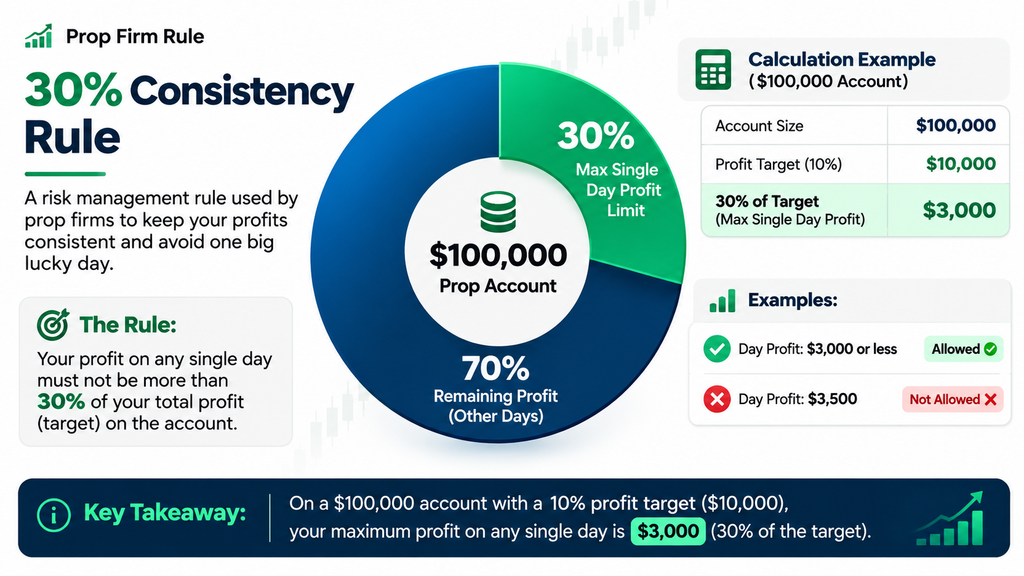
The Hidden Penalty: How One Big Day Increases Your Profit Target
Many traders assume that if they breach the 30% rule, the firm automatically fails their account. In reality, modern firms penalize you by expanding your total profit requirement.
Consider this real-world numerical example on a $100,000 Funded Account:
- Evaluation Profit Target (8%): $8,000
- Firm Consistency Cap: 30%
- Permitted Maximum Single-Day Profit: $8,000 × 0.30 = $2,400
Now imagine on Day 3, you catch a massive 150-pip rally on EURUSD and bank $4,000 in net profit.
Because your best day is $4,000, that $4,000 can only represent 30% of your total required profit before a payout can be processed. To find out what your new profit target becomes, compliance divides your best day by the consistency threshold:
Expanded Profit Target Formula:
New Required Total Profit = Highest Day Profit / Allowed Consistency %New Target = $4,000 / 0.30 = $13,333.33
Instead of finishing your challenge at $8,000, you are now legally forced to keep trading until your total closed profit reaches $13,333.33—requiring an additional $5,333.33 of profit without breaching your daily drawdown vs maximum drawdown limits!
Every additional trade you take exposes your account to market drawdown, drastically increasing the probability that you blow the account before ever reaching the inflated payout threshold.
Pillar 2: The Lot Size Consistency Rule (The Silent Account Killer)
While profit caps catch aggressive breakout traders, the Lot Size Consistency Rule is what terminates systematic technical traders.
Prop firms use automated algorithms to track the volume of every order ticket you execute. If your lot sizes fluctuate wildly—for instance, trading 1.0 lot on EURUSD, then suddenly opening 10.0 lots on Gold, followed by a 0.05 lot trade to pad trading days—your account is instantly flagged for “Lot Inconsistency” or “Gambling Behavior.”
How Lot Size Consistency Is Calculated
Most proprietary firms define an acceptable trading band around your average position volume:
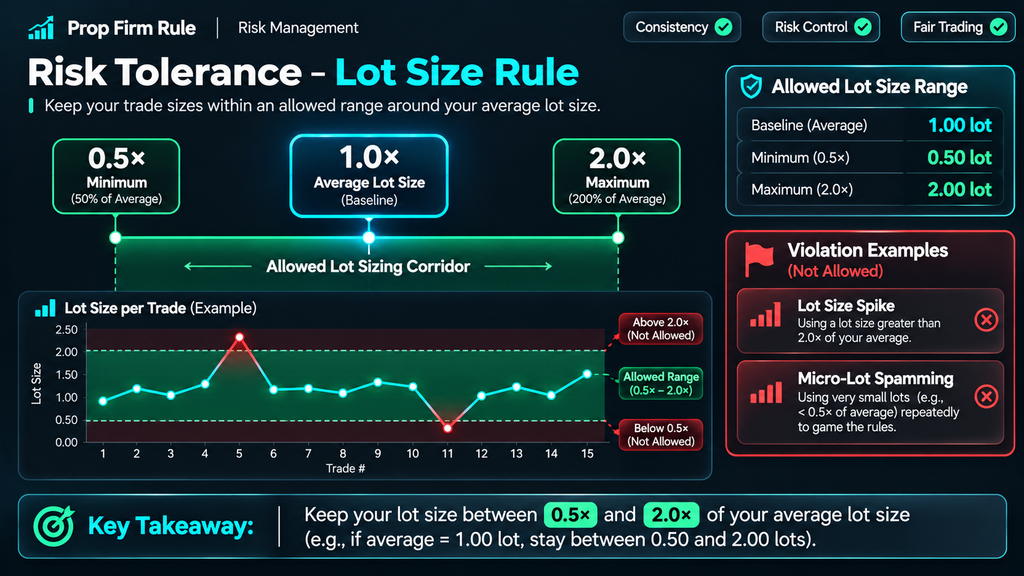
The Micro-Lot “Flipping” Trap
The most common trap retail traders fall into involves minimum trading days.
Suppose a prop firm requires a minimum of 5 trading days to pass Phase 1. A trader hits their entire 8% profit target in two disciplined trading sessions. To fulfill the remaining three days without risking capital, the trader opens and closes a 0.01 lot order on USDJPY on Day 3, Day 4, and Day 5.
Here is how the automated audit evaluates that account:
| Trade # | Symbol | Executed Volume | Realized P&L | Status |
|---|---|---|---|---|
| Trade 1 | XAUUSD | 4.00 Lots | +$2,200 | Normal Setup |
| Trade 2 | XAUUSD | 4.00 Lots | +$1,850 | Normal Setup |
| Trade 3 | XAUUSD | 4.00 Lots | +$2,100 | Normal Setup |
| Trade 4 | XAUUSD | 4.00 Lots | +$1,900 | Target Reached ($8,050) |
| Trade 5 (Day 3) | USDJPY | 0.01 Lots | +$0.12 | Minimum Day Pad |
| Trade 6 (Day 4) | USDJPY | 0.01 Lots | -$0.18 | Minimum Day Pad |
| Trade 7 (Day 5) | USDJPY | 0.01 Lots | +$0.05 | Minimum Day Pad |
- Total Volume Traded: 16.03 Lots
- Total Executed Trades: 7 Trades
- Calculated Average Lot Size: 16.03 / 7 = 2.29 Lots
- Allowed Lower Bound (±50%): 2.29 × 0.50 = 1.14 Lots
- Allowed Upper Bound (200%): 2.29 × 2.00 = 4.58 Lots
Notice what just occurred: Trades 5, 6, and 7 (0.01 lots) are drastically below the 1.14 lot minimum threshold. Simultaneously, the 0.01 trades dragged down the average so severely that the initial 4.00 lot trades are hovering dangerously close to the maximum ceiling.
When the payout request is audited, compliance software flags the 0.01 orders as “artificial activity to bypass trading day requirements.” The payout is denied, and the trader is forced to continue trading.
This is why professional traders use automated quantitative execution journals like Anyted. Anyted’s execution telemetry engine connects directly to your Spotware cTrader Open API or parses MT4/MT5 statements, automatically computing your normalized R-multiples and lot deviation tolerance in real time. By checking your Anyted dashboard before submitting an evaluation completion, you can verify that your volume distribution falls safely within standard institutional audit parameters.
Consistency Rules Comparison Across Major Prop Firms
Consistency policies vary significantly depending on whether you are trading a standard two-phase evaluation, an instant-funding account, or a futures contract challenge:
| Proprietary Firm / Model | Profit Consistency Cap | Lot Size Deviation Limit | Minimum Hold Time | Payout Denial Consequence |
|---|---|---|---|---|
| PropPass Standard (2-Phase) | No Artifical Profit Cap | Risk Guardrail on Order Desk | None (Tick Scalping Protected) | Transparent Rules, Instant Pass Certificate |
| PropPass Pro Swing | Balance-Based Tracking | Dynamic Sizing Calculator | Overnight & Weekend Allowed | Zero Consistency Traps |
| FTMO (Classic Challenge) | No Explicit Cap (Phase 1/2) | Soft Discretionary Review | None | Discretionary Account Review |
| FundedNext (Stellar Challenge) | 20% to 30% on select models | Must stay within range | 2 Minutes on News | Target Expansion / Audit Hold |
| Apex Trader Funding | 30% Consistency Rule | Strict Contract Tier Sizing | None | Payout Denied Until Ratio Balanced |
| MyFundedFX / Funding Pips | 20% to 40% on 1-Phase models | Proportional Lot Rule | 30 to 60 Seconds | Account Reset to Evaluation Base |
Notice the clear divide: legacy firms frequently use discretionary or retroactively calculated consistency caps to withhold payouts during turbulent market months.
Modern execution architectures like PropPass eliminate ambiguous consistency traps by embedding live rule enforcement directly into the trading platform. Rather than calculating retroactive penalties after you trade, PropPass features an automated Pre-Trade Buffer Guardrail and built-in Lot Size Calculator. The Order Desk alerts you in real time if a proposed order risks exceeding your daily buffer, and lets you choose between balance-based tracking (Pro Swing) and static evaluation models without hidden profit caps.
The 4-Step Blueprint to Pass Payout Audits Every Single Time
If your target prop firm enforces a strict consistency rule, you cannot trade on intuition alone. You need an institutional execution protocol. Follow this 4-step framework to guarantee compliance across every trading cycle:
1. Establish Your Daily Profit Circuit Breaker
To prevent a single outsized win from expanding your profit target, calculate your daily profit ceiling before your session begins:
Daily Profit Ceiling Formula:
Daily Profit Ceiling = Target Profit × (Allowed Consistency % - 5% Safety Margin)
If your target profit is $10,000 on a $100,000 account with a 30% consistency rule, your hard ceiling is:
$10,000 × (0.30 - 0.05) = $2,500
The moment your closed and floating P&L reaches +$2,500, you close your terminal and stop trading for the day. Locking in 25% ensures that even with slippage, no single day can ever trigger the 30% profit expansion penalty.
2. Standardize Your Position Sizing by Asset Class
Never adjust your lot size based on “confidence.” When traders feel bullish, they trade 5.0 lots; when uncertain, they trade 0.5 lots. This variance triggers algorithmic volume flags during audits.
Standardize your lot sizing by risk unit:
- If your baseline risk per trade is 0.±50% ($500 on a $100k account), always keep your dollar risk constant.
- Let your stop-loss distance determine your lot size—not your emotional conviction.
- Use the automated lot sizing engine in PropPass, which automatically adjusts lot sizes for Forex pairs, Gold (XAUUSD), and Indices (US30/NAS100) based on your exact stop-loss pips, keeping your lot distribution uniform.
3. Never Spam Micro-Lots for Minimum Trading Days
If you hit your profit target early and need to fulfill 2 or 3 additional trading days, do not open 0.01 lot orders.
Instead, execute your normal trading setup using ±50% of your standard position size:
- If your average lot size was 2.0 lots, trade 1.0 lot.
- Place your standard stop-loss and take-profit orders.
- Let the trade play out normally or close it after a reasonable market move.
A 1.0 lot trade sits comfortably within the ±50% to 200% tolerance band of a 2.0 lot average, completely bypassing automated compliance filters.
4. Audit Your Statements Prior to Payout Request
Never click the “Request Payout” button blind. Before requesting a payout or submitting an evaluation for Phase 2 upgrade:
- Export your MT5, MT4, or cTrader closed deal statement.
- Ingest your trade data into Anyted.
- Review your Peak-to-Trough Max Drawdown, daily profit distribution, and MAE/MFE excursions.
- Confirm that your highest single day represents less than the firm’s mandated cap.
If you discover that Day 4 generated 34% of your total profit under a 30% rule, take one or two small, disciplined trades over the next two days to slightly grow your total profit base until Day 4 drops to 29.5%. By balancing the denominator before compliance audits your account, you ensure immediate payout approval.
Frequently Asked Questions (FAQ)
What happens if I accidentally breach the consistency rule?
In most reputable prop firms, breaching the consistency rule on an evaluation account does not result in an immediate account termination (hard breach). Instead, the firm expands your total profit target or delays your payout until you execute additional profitable trades that balance your profit distribution. However, on instant funding or live funded accounts, some firms may deny the payout or revoke the account under discretionary clauses.
Does the consistency rule apply to evaluation challenges or only funded accounts?
It depends on the firm. Some firms (like Apex Trader Funding) enforce the consistency rule during both evaluation and funded phases. Other firms enforce consistency only during the funded payout stage to prevent traders from gambling with company capital. Always review your firm’s specific FAQ or choose transparent models like PropPass that provide clear upfront parameters.
Can I hold trades over the weekend under a consistency rule?
Holding trades over the weekend does not directly violate consistency rules unless the firm explicitly bans weekend holding. However, weekend rollover gaps and triple-swap charges can trigger unexpected balance shifts that skew your daily profit calculations. For swing trading, select balance-based evaluations like PropPass Pro Swing, which explicitly permit weekend holding without penalizing floating equity swings.
How does cTrader Open API help prevent consistency breaches?
Direct API connections—such as Spotware cTrader Open API integration available in Anyted—stream live execution telemetry without relying on delayed third-party statement uploads. This provides instant visibility into commission-adjusted net P&L and volume variance, allowing you to self-audit your account before compliance officers review your trades.
Final Verdict: Trading Like an Institutional Operator
The prop firm consistency rule is not an obstacle designed to defeat you—it is an institutional risk framework designed to eliminate retail gambling habits.
Traders who rely on high-risk lottery setups, emotional position sizing, and revenge trading will inevitably run afoul of consistency audits. But traders who treat their funded accounts like a quantitative business—capping single-day profits, standardizing lot sizes, and utilizing institutional tools like Anyted and PropPass—navigate consistency rules effortlessly and collect consistent monthly payouts.