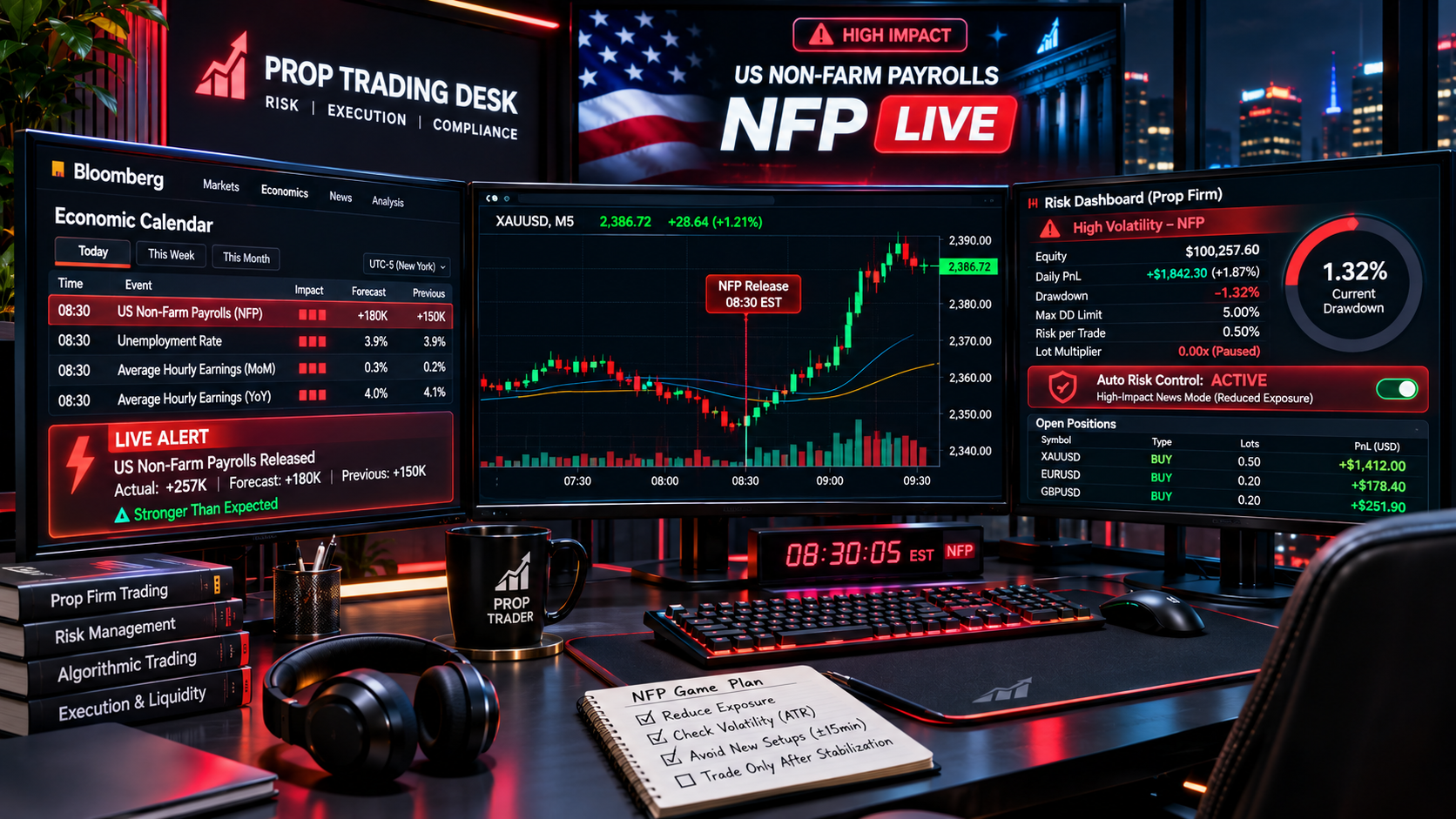
It is 8:29 AM Eastern Time on the first Friday of the month. In sixty seconds, the United States Bureau of Labor Statistics will publish the Non-Farm Payrolls (NFP) report.
You sit in front of your $100,000 funded account. You anticipate a weak employment figure, so you open a 5.0-lot Buy order on Gold (XAUUSD) with a tight 30-pip stop-loss, risking exactly $1,500.
At 8:30:00 AM, the number prints. In less than three seconds, the market experiences a violent liquidity vacuum. Price whipsaws downward 80 pips before launching into the stratosphere. You check your terminal expecting a massive profit, only to find your screen frozen. When the quotes reconnect, your position has been closed at a catastrophic loss: your 30-pip stop-loss slipped by 55 pips, liquidating $4,250 from your balance and instantly breaching your 5% daily drawdown limit.
Even if you managed to catch the upward move and banked $6,000, your relief is short-lived. Two days later, compliance audits your closed trades, deletes the entire $6,000 profit, and slaps a formal warning on your account:
“Violation of News Trading Policy: Opening or closing orders within the restricted 2-minute event window.”
Understanding prop firm news trading rules is one of the most critical survival skills in modern proprietary trading. Many retail traders fail evaluations not because their market directional bias was wrong, but because they completely misunderstood how broker liquidity bridges, spread widening, and strict compliance restriction windows operate during high-impact economic events.
In this operational guide, we break down why prop firms restrict news trading, how the 2-minute buffer rule works in practice, the brutal mathematics of stop-loss slippage, which major firms permit news trading, and the exact risk protocols you need to protect your funded capital.
Why Prop Firms Restrict News Trading: The Liquidity Desk Reality
To understand why prop firms enforce strict news trading boundaries, you must look at what happens behind the scenes of an institutional liquidity bridge.
In calm market conditions, major currency pairs like EURUSD or USDJPY trade with spreads under 0.5 pips. Thousands of buy and sell limit orders sit in the interbank order book, providing deep liquidity.
However, during Tier-1 economic releases—such as US CPI, Federal Reserve Interest Rate decisions, or NFP—institutional liquidity providers (Tier-1 banks and market makers) do not want to be caught on the wrong side of a macro repricing event. Consequently, they withdraw their limit orders from the book 30 to 60 seconds before the news release.
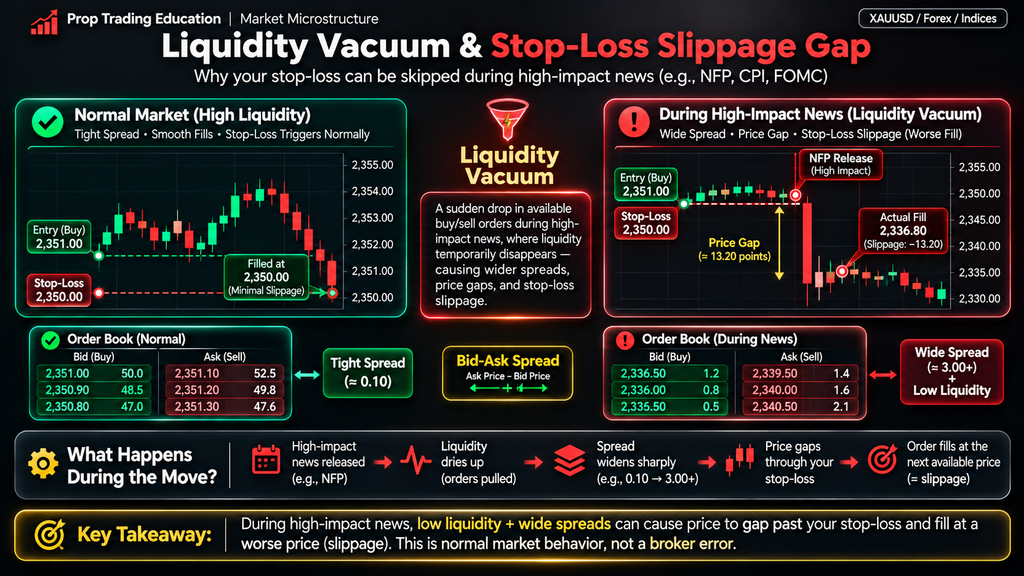
This withdrawal creates a massive liquidity vacuum:
- Spreads Explode: EURUSD spreads instantly widen from 0.2 pips to 6 or 10 pips. Gold spreads can expand from 1.5 pips to over 25 pips in a fraction of a second.
- Order Book Thinning: Because few orders exist at intermediate price levels, the price does not move smoothly from tick to tick. It “gaps” across 20 to 50 pips in a single millisecond.
- Asymmetric Slippage: If you submit a market order or hit a stop-loss, your order cannot be filled at your requested price because no counterparty exists at that price level. Your broker bridge executes your order at the next available price—often tens of pips worse than your chart indicated.
For prop firms that pass their funded volume to live liquidity pools (A-Book), news gambling generates toxic flow that liquidity providers reject or heavily penalize. For firms operating simulated demo environments (B-Book), virtual demo bridges fill orders at artificial prices that do not reflect real market conditions. To protect their business model from speculative arbitrage, prop firms implement formal prop firm news trading rules.
The 3 Common Prop Firm News Trading Frameworks
Proprietary trading firms generally categorize news trading into three distinct regulatory models:
1. The Strict 2-Minute Restriction Window (The Industry Standard)
The most common restriction enforced across top firms (such as FTMO Funded Accounts, FundedNext, and The Funded Trader) is the 2-Minute News Window:
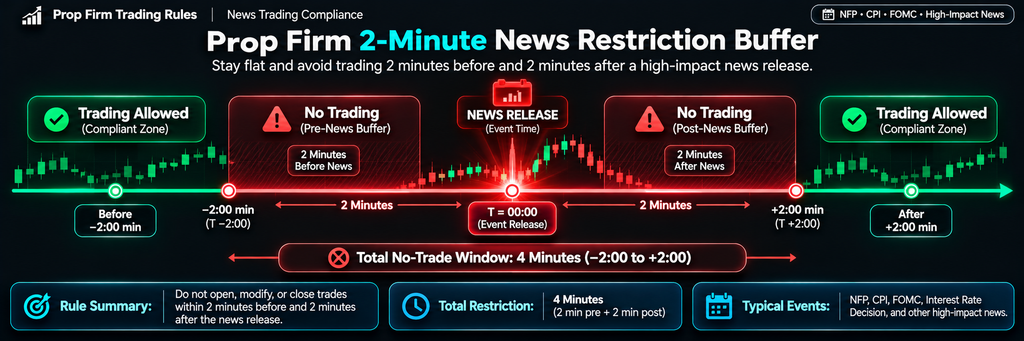
The 2-Minute News Rule:
Traders are strictly prohibited from opening, closing, or executing pending orders within 2 minutes before and 2 minutes after the official release of high-impact macroeconomic news.
Here is how the 2-minute rule applies to different trade scenarios:
- Scenario A (Opening a Trade): If US CPI prints at 8:30:00 AM, opening a trade between 8:28:00 AM and 8:32:00 AM is a direct rule violation.
- Scenario B (Closing a Trade): If you entered a trade two hours earlier, but you manually click “Close” at 8:30:15 AM to lock in quick news profits, you have breached the rule.
- Scenario C (Pending Orders): If a pre-set Buy Stop or Sell Limit order is triggered between 8:28:00 AM and 8:32:00 AM, the execution is considered a violation.
2. Profit Cancellation vs. Hard Account Breach
What happens when you accidentally execute a trade inside the restricted window? Prop firms typically handle violations in two ways:
- Soft Breach (Profit Withholding): Most reputable firms do not terminate your account on a first offense. Instead, the firm’s compliance engine automatically identifies trades executed during the restricted window and cancels all net profits generated by those trades. However, if the news trade resulted in a loss that breached your daily drawdown vs maximum drawdown limit, the account loss is fully counted and the account is permanently failed!
- Hard Breach (Immediate Account Liquidation): On certain specialized challenges (such as aggressive instant-funding accounts or HFT-permitted accounts), executing a trade during prohibited news events results in instant account termination without refund.
3. Holding Existing Swing Trades Through News (Permitted vs. Prohibited)
Many prop firms distinguish between initiating new orders during news versus holding long-term swing positions.
Under firms with flexible swing trading frameworks—such as PropPass Pro Swing—traders are fully permitted to hold existing swing trades through high-impact news events and over weekends. Because PropPass Pro Swing uses balance-based daily drawdown tracking rather than equity-based trailing thresholds, temporary floating equity swings and spread widening during news releases do not trigger artificial liquidation traps.
The Red-Folder News Calendar: Which Events Trigger Restrictions?
Prop firms do not restrict trading during every news announcement. Restrictions apply almost exclusively to Tier-1 High-Impact Economic Releases (often color-coded as “Red Folders” on economic calendars such as ForexFactory, Investing.com, and FXStreet).
High-Impact Events Restricted by Currency:
| Currency | Tier-1 Economic Event Name | Release Frequency | Typical Volatility Impact |
|---|---|---|---|
| USD | Non-Farm Payrolls (NFP) & Unemployment Rate | Monthly (First Friday) | 80 to 150 Pips on Forex & Gold |
| USD | Consumer Price Index (CPI) & Core Inflation | Monthly | 60 to 120 Pips across all USD pairs |
| USD | FOMC Interest Rate Decision & Press Conference | 8 Times per Year | 100 to 200 Pips + Multi-directional Whipsaws |
| USD | Gross Domestic Product (GDP) Advance Release | Quarterly | 40 to 80 Pips |
| EUR | ECB Monetary Policy Statement & Press Conference | 8 Times per Year | 50 to 100 Pips on EUR pairs |
| GBP | Bank of England (BOE) Bank Rate Decision | 8 Times per Year | 70 to 130 Pips on GBP pairs |
| CAD | Canada Employment Change & Unemployment Rate | Monthly | 50 to 90 Pips on USDCAD |
| AUD / NZD | CPI & Reserve Bank Rate Statements (RBA / RBNZ) | Quarterly / Monthly | 40 to 80 Pips on Oceanic pairs |
The “Related Currency” Rule
A common mistake made by funded traders is misunderstanding currency correlation. If US CPI is released at 8:30 AM:
- Trading EURUSD, GBPUSD, USDJPY, and USDCAD is strictly restricted.
- Trading XAUUSD (Gold) and US Indices (US30, NAS100, SPX500) is also restricted, because Gold and Indices are priced directly in US Dollars.
- However, trading a non-USD cross (such as EURGBP or AUDNZD) is typically permitted, provided that the cross does not contain the affected currency.
The Mathematics of Stop-Loss Slippage During News
Many retail traders assume that placing a stop-loss guarantees their maximum downside risk. In reality, a stop-loss is not a guaranteed contract; it is an instruction to trigger a Market Order.
When market prices gap during high-impact news, slippage can destroy your account equity in seconds. Consider the following mathematical breakdown on a $100,000 Prop Firm Account:
- Account Capital: $100,000
- Maximum Daily Loss Limit (5%): $5,000
- Your Risk Budget for the Trade: 1.0% ($1,000)
- Symbol: Gold (XAUUSD)
- Entry Price: 2,650.00 | Planned Stop-Loss: 2,645.00 (50 Pips)
- Calculated Lot Size: 2.0 Lots ($20 per pip risk × 50 pips = $1,000 risk)
What Happens in a Normal Market vs. News Liquidity Gap:
Normal Market Execution:
- Price moves smoothly: 2649.90 -> 2647.50 -> 2645.00
- Stop-loss order is triggered and filled at 2645.00.
- Realized Loss: -$1,000.00 (Within planned 1.0% risk budget).

News Liquidity Vacuum Gap:
- High-impact CPI number prints hotter than expected.
- Price instantaneously jumps from 2651.20 to 2636.00 without any intermediate ticks!
- Your stop-loss order at 2645.00 is triggered, but no buyer exists at 2645.00.
- The broker bridge executes your market order at the next available price: 2636.00!
- Slipped Distance: 2,645.00 - 2,636.00 = 90 PIPS OF NEGATIVE SLIPPAGE!
- Total Executed Loss: 140 Pips × $20/pip = -$2,800.00!
In this real-world scenario, your trade did not lose $1,000. It lost $2,800.00—nearly triple your intended risk! If you had two positions open simultaneously, this single news event would wipe out $5,600, exceeding your $5,000 daily drawdown limit and liquidating your funded account permanently.
This is why quantitative execution journals like Anyted are essential for serious prop traders. By connecting your Spotware cTrader Open API or importing MT5 statements into Anyted, you can audit your exact execution slippage variance and MAE/MFE excursions across past economic releases. Anyted reveals whether your broker bridge delivers clean fills or subjects your orders to predatory execution drag.
Prop Firm News Trading Rules: Major Firms Comparison Table
Before purchasing an evaluation challenge, compare how different proprietary trading platforms govern news trading in 2026:
| Proprietary Firm / Platform | Evaluation Phase News Rules | Funded Account News Rules | 2-Minute Window Enforced? | Violation Consequence | Recommended Model |
|---|---|---|---|---|---|
| PropPass (Standard & Express) | 100% Allowed with Guardrails | Allowed with Risk Warning | No Artificial Profit Wipes | Transparent Rules, Drawdown Guardian | All Trading Styles |
| PropPass Pro Swing | Fully Permitted | Fully Permitted | None (Weekend & News Allowed) | Balance-Based Daily Tracking | Swing & Macro Traders |
| FTMO | Fully Allowed (Phase 1 & 2) | Restricted on Classic Funded | Yes (2 Min Before / After) | Profit Cancelled, Loss Retained | FTMO Swing Model |
| FundedNext | Allowed on Stellar 2-Phase | Restricted on Express Models | Yes (Selected Account Types) | Profit Deducted from Payout | Stellar 2-Phase |
| The5ers (Hyper Growth) | Fully Allowed | Allowed with Low Leverage | None | Flexible News Framework | Experienced Scalpers |
| Apex Trader Funding | Allowed (Trailing Stop Active) | Restricted During Halts | Order Halts on CME Volatility | Payout Denied if Daily Loss Breached | Futures Scalpers |
Notice how modern execution suites like PropPass solve the news trading dilemma:
- Instead of penalizing traders with surprise profit deductions after weeks of trading, PropPass integrates a Pre-Trade Buffer Guardrail directly into the Order Desk.
- If a trader attempts to open an oversized order ahead of a volatile economic release that threatens their remaining daily loss buffer, the platform issues an immediate alert before the trade enters the market.
- For swing traders, the PropPass Pro Swing model eliminates artificial news restrictions entirely by tracking daily drawdowns based on starting balance rather than floating intraday equity whipsaws.
How to Trade Around High-Impact News Without Violating Rules
If your prop firm enforces news trading restrictions, you do not have to abandon trading on news days. You simply need an institutional game plan:
1. The Post-News Volatility Fade Strategy
Instead of gambling inside the 2-minute danger window, wait for the initial reaction to exhaust itself:
- Allow the news release to occur at 8:30 AM.
- Wait 15 to 20 minutes for the 2-minute restriction window to expire, institutional order books to replenish, and spreads to compress back to baseline levels.
- Identify key support/resistance levels tested by the initial news spike.
- Enter a mean-reversion or trend-continuation trade at 8:50 AM with tight, normal spreads and zero compliance risk.
2. Pre-News De-Risking Protocol
If you have an active swing trade in profit heading into a high-impact release:
- Take Partial Profits: Close 60% to 80% of your position 30 minutes before the news release.
- Move Stop-Loss to Breakeven + Buffer: Move your stop-loss past your entry point to cover potential spread expansion.
- Verify Daily Buffer in PropPass: Check your remaining daily loss headroom to ensure that even worst-case slippage cannot touch your daily liquidation threshold.
3. Maintain Account Consistency
Prop firms cross-reference news trading with their prop firm consistency rule. If 80% of your total evaluation profit comes from a single 3-minute news candle, compliance audits will expand your profit target or reject your payout. Distributing your profits across regular trading sessions ensures immediate payout approval.
Frequently Asked Questions (FAQ)
What happens if my Take-Profit (TP) is hit during the 2-minute news window?
In most prop firms that enforce the 2-minute rule, if an existing position hits its pre-set Take-Profit order during the restricted window, the firm’s compliance engine will deduct the profit generated by that trade from your payout request. To avoid this, either close the position 10 minutes prior to the news release or widen your take-profit beyond the immediate news spike range.
Do news trading rules apply to crypto trading or only Forex?
News trading restrictions primarily target assets directly impacted by economic data—specifically Forex pairs, Gold (XAUUSD), and Stock Indices (US30, NAS100). Cryptocurrency pairs (like BTCUSD or ETHUSD) are generally not restricted during US economic prints unless the firm enforces an across-the-board news halt on all instruments.
Can I trade news on evaluation challenges and switch strategies when funded?
While many firms permit news trading during Phase 1 and Phase 2 evaluations, using high-risk news spikes to pass challenges creates bad habits that will fail once you reach the funded stage where the 2-minute restriction applies. It is far more profitable to practice disciplined risk management on platforms like PropPass from day one.
How do prop firms verify the exact second a trade was executed?
Prop firms use automated bridge compliance software (like Centroid Solutions and PrimeXM) that logs every order ticket with microsecond timestamps synchronized to UTC. Compliance algorithms cross-reference your execution timestamps against economic calendar APIs, instantly flagging any ticket that overlaps with restricted windows.
Final Verdict: Mastering Macro Volatility Responsibly
High-impact economic news releases represent the greatest concentrations of liquidity and volatility in global financial markets. But in the proprietary trading space (Prop Firms Category), volatility without structural risk control is financial suicide.
Traders who treat news releases as binary lottery events will inevitably face slipped stop-losses, blown daily drawdown limits, and rejected payouts. But traders who understand prop firm news trading rules, respect institutional liquidity vacuums, and audit their execution performance through Anyted and PropPass turn macro volatility into a controlled, repeatable advantage.